
KOKO Plastic Surgery · Eye Surgery
Double Eyelid Surgery
A double eyelid that suits your eyes and your face
Double eyelid surgery creates a crease that suits the shape of your eyes. We look at your face shape, lash position, and the thickness and shape of your eyelids to set the width and line of the crease.
The design also takes into account your epicanthal fold, the bone above the eye, how the eye-opening muscle works, and the crease you want. We then choose between the non-incisional and incisional methods.
- Surgery time
- About 1 hour
- Anesthesia
- Sedation or local anesthesia
- Hospital stay
- Not needed
- Stitch removal
- After 4–6 days
- Recovery
- About 1 week
What is the non-incisional method?
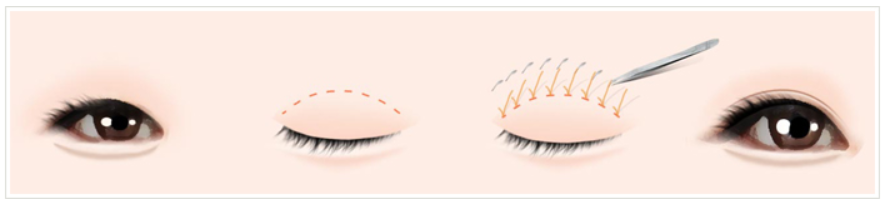
This method creates the crease with sutures and is also called the buried suture method. The skin is not cut. Instead, sutures pass through tiny needle holes to form the crease.
We make 3–4 holes about 1 mm across in the eyelid. A suture runs from the skin side to the conjunctiva side and comes out through another hole. It is then tied so the muscle and skin hold together.
The non-incisional method suits people who:
- Have thin, elastic eyelids with little fat
- Have no sagging eyelid skin
- Sometimes show a faint crease already
- Want a narrow inner double eyelid
What is the incisional method?
This method creates the crease through an incision in the eyelid skin. Depending on how much is cut, it can be a partial incision or a full incision.
Because sagging skin and thick muscle or fat can be removed while the crease is made, it suits people who:
- Have sagging, excess eyelid skin
- Have thick skin with thick layers of muscle and fat
- Need sagging skin and fat removed at the same time
- Have ptosis that makes the eyes look sleepy
- Need revision for a crease set too high, or for scars
Swelling and recovery
How quickly swelling goes down varies from person to person. With the incisional method, about 70% of the swelling settles in 1–2 weeks, and the remaining mild puffiness fades over 2–3 months.
Because the non-incisional method does not cut the skin, swelling is relatively mild. You can wash your face and wear makeup from day 3 or 4 after surgery.
Risks and side effects
Results and recovery vary from person to person. The main risks and side effects are:
- Swelling and bruising after surgery or treatment
- Infection or inflammation
- Asymmetry, or a result that differs from what you pictured
- Scarring (when an incision is made)
- Numbness or changes in sensation (often temporary)
If anything concerns you, you can still reach us on WhatsApp after you fly home.
Non-incisional vs. incisional
We choose the method that fits your eyelids
Here is how each method works, with its pros and cons.
Types of incisional surgery
-
Partial incision
This combines the strengths of the incisional and non-incisional methods, aiming for a natural, clean eye area.
Unlike the non-incisional method, which only holds the crease with sutures, it encourages the skin and tissue to bond firmly. The crease is therefore less likely to come undone.
It is also used for revisions where sagging skin or scars stand out. A minimal incision tightens the sagging skin and keeps the scar as small as possible.
Revision Eye Surgery -
Full incision
This is a long-established, widely used method. Through a skin incision, sagging eyelid skin, muscle and fat layers are removed to create a well-defined crease.
It suits people with sagging eyelids, people who need muscle or fat removed, and people who need ptosis correction.
Surgery takes about 30 minutes to 1 hour, and the stitches come out on day 4 or 5.
Eye Contour Correction
Non-incisional method: pros and cons
-
Pros
Because the skin is not cut, swelling is relatively mild and scars are hard to see.
Surgery is fairly short, at about 20–30 minutes.
The crease tends to look natural, and it is hard to tell you had surgery.
Partial adjustments are easy, and it can be redone in a revision.
You can wash your face and wear makeup from day 3 or 4, so you get back to daily life quickly.
-
Cons
The crease can come undone. It also cannot remove sagging skin, muscle or fat.
Because the skin is not cut, the skin can sag over time and the crease can become narrower.
If your skin is thin, you may feel or see the suture knots.
It does not suit eyes with a lot of fat or muscle, or sagging skin.
Incisional method: pros and cons
-
Pros
It works for eyes with a lot of fat and a thick fat layer.
If the skin sags, the excess skin can be removed during the same surgery.
It creates a more defined crease than the non-incisional method.
It can be used on many different eye types.
-
Cons
Swelling takes longer to go down than with the non-incisional method.
The scar is hard to see, but it does remain.
It is done under local anesthesia and takes about 1 hour.
WHY KOKO
Why patients choose KOKO for Double Eyelid Surgery
- 01
25 years in practice
Since opening in 2001, we have practiced cosmetic surgery in Apgujeong, Seoul, for 25 years.
- 02
Planned around your whole face
KOKO Plastic Surgery opened in 2001 as the first clinic in Apgujeong specializing in nose surgery. Drawing on that experience, we design your double eyelids around the balance of your whole face.
- 03
Dr. Cho, from consultation to surgery
Dr. Cho Bae-jung, our representative director and a board-certified plastic surgeon, handles your consultation and performs your surgery himself.
How long to stay
For double eyelid surgery, plan to stay about a week
Stitches come out 4–6 days after surgery, and you can fly home once they are out. Recovery differs between the non-incisional and incisional methods, so we plan your schedule together at your consultation.
-
Day 1
Visit and consultation
Dr. Cho checks your eye shape and eyelids, and decides the crease width and the method. A medical interpreter joins you.
-
Surgery day
Surgery
About 1 hour under sedation or local anesthesia. No hospital stay.
-
Following days
Follow-up checks
Disinfection and swelling checks. You come in from where you are staying.
-
Days 4–6
Stitch removal
We remove the stitches and check the incisions. Recovery takes about 1 week.
-
Flying home
Surgery certificate
We prepare the documents you need to leave Korea. You can still reach us on WhatsApp after you fly home.
- Medical interpreterA professional medical interpreter joins your consultation and surgery
- Airport transferOne-way or round-trip, depending on your surgery fee
- AccommodationA guesthouse is provided. You can switch to a hotel
- Service details
FAQ
Common questions about Double Eyelid Surgery
-
The non-incisional method suits thin eyelids without sagging skin. The incisional method suits sagging skin, a lot of fat, or ptosis. Dr. Cho examines your eyes at the consultation and recommends a method.
-
Yes. Because the crease is held with sutures, it can come undone. The skin can also sag over time and narrow the crease. If you want a crease that is less likely to come undone, you can choose a partial or full incision.
-
It varies from person to person. With the incisional method, about 70% of the swelling settles in 1–2 weeks, and the remaining puffiness fades over 2–3 months. The non-incisional method causes relatively mild swelling, and you can wash your face and wear makeup from day 3 or 4.
-
Surgery takes about 1 hour, with no hospital stay. Stitches come out after 4–6 days and recovery takes about 1 week, so plan on about a week.
-
It depends on the method and whether you combine it with other eye procedures. Send three photos of your face — front, side and 45° — on WhatsApp (+82 10-9608-0042), and we will give you an estimate. We can also go over it in an online consultation.
How to start
Getting started is easy.
Book a consultation online, or send us your questions on WhatsApp. We will reply in English.
- Book online
Choose a date and time that suits you for your consultation.
- Ask on WhatsApp
A short question is enough to start.
- Photos are optional
Front, side and 45° photos help us give you a more specific cost estimate.

Scan with your phone to open a WhatsApp chat with us (+82 10-9608-0042).