


The "Invisible Nose": A Complete Guide to 2026 Korean Rhinoplasty Trends — Design Philosophy for Natural Results and KOKO's Approach
The Korean aesthetic surgery industry has seen dramatic shifts in nose design trends every few years. After an era that prized sharply elevated tips and slender, defined bridges, the concept now leading the field in 2026 is the "invisible nose" — known in Korean as 잊혀지는 코 (ijyeojineun ko). As the name suggests, it refers to a nose so seamlessly integrated with the face that observers barely register its presence.
Among patients traveling from Japan to Seoul for rhinoplasty, a consistent refrain has emerged in consultations year after year: "I'm afraid it will look obviously operated on" and "I don't want my friends to immediately notice I've had surgery." These concerns align perfectly with the invisible nose concept. This article explores the background, philosophy, and technical foundations of this trend, along with the approach practiced by Dr. Cho Bae-jeong, Director of KOKO Plastic Surgery — including candidacy, limitations, recovery, and risks.
What Is the "Invisible Nose"? The Concept and Its Origins
The term "invisible nose" began circulating in Korean cosmetic surgery communities and on social media around 2024, and by 2026 it has become established common language among specialists. At its core is a design philosophy centered on a nose that does not disturb the harmony of the face as a whole.
Earlier rhinoplasty trends sometimes treated maximizing a single attribute — height, slenderness, sharpness — as the measure of beauty. The resulting noses often read as "too assertive," both head-on and in profile, and no small number of patients later sought revision surgery. The invisible nose approach draws on those lessons, taking the individual's skeletal structure, skin thickness, and existing nasal support as the starting point, and aiming for a nose that looks as though it was always part of that person's face.
Key characteristics include:
- Bridge height proportioned to the face rather than pushed to an extreme
- A tip that sits in a natural position without being made unnecessarily narrow or pointed
- Preservation of the structural balance between skin and cartilage, with emphasis on long-term shape stability
- A result that looks at ease from every angle — front, profile, and three-quarter view
- Appearance that remains natural through changes in expression, including smiling and speaking
The goal is not simply to be "understated." It is to create the nose that best harmonizes with a particular person, using techniques capable of sustaining that result over time. Depending on the case, this may include augmentation procedures or cartilage-based reconstruction.
Why the "Invisible Nose" Now? Four Reasons Behind the Trend
1. The Maturation of Social Media and Video Culture
As platforms like Instagram and TikTok have made it routine to share one's face from multiple angles and in motion, the demand has shifted from "a nose that looks good in a front-facing photo" to "a nose that looks natural on video and in profile." A nose that reads as genuine even without filters — that is one of the forces driving interest in the invisible nose.
2. The Growing Number of Revision Patients and the Lessons Learned
Revision rhinoplasty cases in Korea have been on an upward trend for more than a decade. The accumulated experience has made it widely understood — among both surgeons and patients — that choosing an overly bold design at the initial surgery raises the likelihood of future revision. There is now a much stronger shared awareness that a naturally sustainable design is the right choice from the outset.
3. Advances in Materials and Technique
Rhinoplasty using autologous cartilage — from the ear, nasal septum, or rib — has matured considerably, making it possible to achieve natural texture and structural stability without relying solely on implants. This allows for designs that do not depend on materials prone to an "operated" appearance.
4. The Globalization of Beauty Ideals and the Rise of Individuality
The era of chasing a single universal "ideal nose" is giving way to one in which people seek the nose that suits their own face. The idea of improving one's appearance while working with — rather than erasing — the distinctive features of Japanese, Korean, or Chinese bone structure maps directly onto the invisible nose philosophy.
The Design Philosophy Behind the "Invisible Nose": Dr. Cho Bae-jeong's Approach at KOKO Plastic Surgery
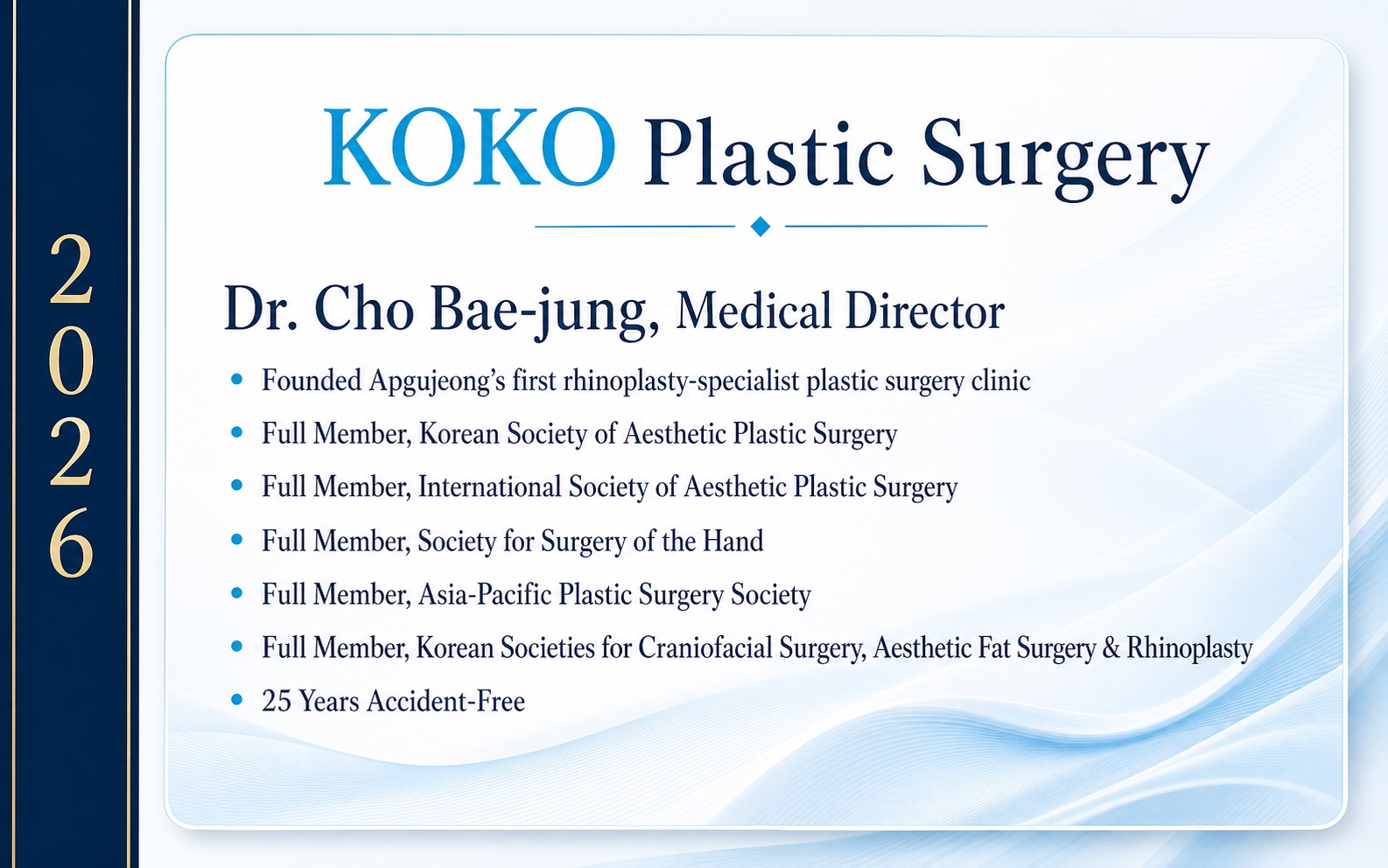
Dr. Cho Bae-jeong, Director of KOKO Plastic Surgery in Apgujeong, Seoul, has specialized in rhinoplasty and revision rhinoplasty for more than 25 years. His clinical philosophy aligns deeply with the invisible nose concept, and that philosophy is supported by a continuity-of-care model in which a single surgeon handles everything from consultation through surgery.
Individualized Design That Starts With Diagnosis
The first thing Dr. Cho does is not assess the nose in isolation — it is to diagnose the structural balance of the face as a whole. The height of the glabella, the slope of the forehead, the distance between the eyes and nose, the projection of the chin, skin thickness, and cartilage strength are all evaluated together before a design is determined: "For this face, this degree of height and this nasal tip shape will achieve the most harmonious result."
For patients from Japan, specific considerations come into play: a tendency toward relatively thicker skin, significant individual variation in septal cartilage strength, and distinctive patterns of alar flare common among East Asian patients. Applying a standard Korean-patient template would be a mistake. A design tailored to each individual's features is the fundamental prerequisite of the invisible nose.
Material Selection and Long-Term Stability
The choice of materials has an enormous bearing on how well an invisible nose holds up over time. KOKO Plastic Surgery takes an approach that actively incorporates autologous tissue — ear cartilage, septal cartilage, rib cartilage, fascia — rather than relying exclusively on silicone implants. Autologous tissue integrates well with the body and offers the prospect of greater long-term shape stability, though the usable amount and site-specific availability vary from patient to patient. Which materials are appropriate for a given individual is determined through examination.
Septal Intervention and Structural Support
Maintaining the natural shape and projection of the nasal tip over time depends critically on structural support from the nasal septum — the internal partition of the nose. Depending on skin thickness and cartilage condition, septal extension or septal reconstruction may be necessary. These procedures increase the technical complexity of surgery, but they contribute substantially to lasting shape stability. Reconstructive nasal surgery involving the septum is one of Dr. Cho's areas of specialization, and he has extensive experience managing revision cases.
Candidacy and Limitations: Who Is — and Who May Not Be — a Good Fit
The invisible nose approach cannot be applied in the same way to every patient. Understanding candidacy and limitations clearly is the first step toward a satisfying outcome.
Cases Likely to Benefit
- Those considering primary rhinoplasty who want a natural-looking change
- Those who want to avoid an "obviously operated" nose and prefer that the procedure go unnoticed
- Those who want to refine the height and shape of their nose moderately while preserving harmony with their bone structure
- Those who prioritize a stable, long-lasting result and want to reduce the likelihood of future revision
- Those who feel a previous surgery went too far and want to restore a more natural appearance
Cases Requiring Caution / Limitations
- Very thick skin can limit how much change is visible at the nasal tip, potentially creating a gap between expectations and results
- Multiple prior surgeries with significant scar tissue can restrict design flexibility
- Insufficient cartilage strength or volume may constrain what shapes are achievable
- Because the invisible nose prioritizes naturalness, it may not meet the expectations of patients seeking dramatic transformation
- Systemic health conditions, current medications, and allergies may affect surgical candidacy
What approach is most appropriate for any given individual cannot be determined without an actual examination. An online consultation can provide general guidance on direction, but the final assessment requires an in-person visit.
Recovery and Downtime: A Realistic Picture
The recovery from invisible nose surgery varies considerably depending on the scope of the procedure, individual constitution, and other factors. The following is offered as a general reference — individual experiences differ widely.
Week One
Swelling and bruising appear immediately after surgery. A cast or splint will be in place, limiting social activity and outings during this period. Swelling typically peaks around days two to three and then begins to subside. KOKO Plastic Surgery offers hyperbaric oxygen therapy as part of its post-operative care program, which may help reduce swelling and support recovery.
Weeks Two Through Four
Visible swelling improves substantially, and most patients are able to resume daily activities. Some firmness or tension may still be felt to the touch, and the final appearance has not yet been reached. Strenuous exercise, saunas, and alcohol should continue to be avoided.
Months Three Through Six
Soft-tissue edema gradually resolves and the shape begins to stabilize. In particular, fine details of the nasal tip may continue to evolve through this period. Evaluating the finished result of an invisible nose requires at least three months of follow-up.
Six Months to One Year
The nose generally reaches its near-final state during this period. Depending on individual constitution, the materials used, and the scope of surgery — such as when costal cartilage has been used — the timeline may extend further.
Risks and Post-Operative Considerations
Every surgical procedure carries some degree of risk, and rhinoplasty aimed at achieving an invisible nose is no exception. The following are the principal risks and considerations, presented honestly.
- Infection: Bacterial infection at the surgical site is possible and is managed with appropriate care and monitoring.
- Hematoma / Seroma: Accumulation of blood or fluid may occur after surgery and may require intervention.
- Asymmetry or Shape Changes: Minor asymmetry may become apparent as swelling resolves. Shape changes over the long term are also possible.
- Implant-Related Issues: In cases involving a prosthetic implant, rare complications can include infection, displacement, or extrusion. Autologous tissue carries its own potential for resorption or deformation.
- Scarring: Scarring at incision sites is possible; visibility depends on individual healing characteristics.
- Sensory Changes: Temporary — and in rare cases more prolonged — alterations in sensation, such as numbness or hypersensitivity, may occur.
- Need for Revision: Depending on the post-operative course, corrective surgery may become necessary.
These risks do not occur with equal likelihood in every patient, but awareness of each is important. Any questions you have during the pre-operative consultation should be raised and fully addressed.
Frequently Asked Questions (FAQ)
Q1. Is the "invisible nose" the same as a conservative rhinoplasty?
Not necessarily. The invisible nose is a concept defined by its goal — a naturally integrated result — not by the scale of the procedure required to achieve it. In some cases, reaching that goal may involve a relatively extensive surgery using costal cartilage. Think of it less as "understated" and more as "whatever serves this face best."
Q2. Can patients of Japanese descent achieve an "invisible nose"?
Yes — but doing so requires a design that accounts for the specific anatomical characteristics common among Japanese patients, including skin thickness and cartilage condition. Simply applying a Korean-patient template is not appropriate. What degree of change is realistically achievable needs to be established through examination.
Q3. I've had rhinoplasty at another clinic. Can the result be revised to achieve an invisible nose?
Under the right conditions, revision surgery can move the result toward a more natural appearance. However, the difficulty and the scope of what can be corrected depend heavily on the nature of the previous surgery, the materials used, and the current state of the nose. The appropriate starting point is a thorough examination of the current condition, followed by a frank discussion of what approaches make sense. KOKO Plastic Surgery includes revision rhinoplasty as one of its areas of specialization and accepts consultations from patients seeking correction after surgery at other clinics.
Q4. How long after surgery can I see the finished "invisible nose" result?
In general, major swelling resolves and the shape begins to stabilize around three to six months post-operatively. Assessing the final result may take six months to a year. That said, the timeline varies based on individual constitution, the scope of surgery, and the materials used. Post-operative follow-up is essential to understanding your recovery.
Q5. Can I have a consultation in English?
Yes. KOKO Plastic Surgery offers consultations in English, Japanese, Korean, and Chinese. From an initial online consultation before traveling to Seoul through in-person examination, surgery, and post-operative care, full support is available in your preferred language. Please feel free to reach out via WhatsApp to get started.
Why KOKO Plastic Surgery Is Well Suited for the "Invisible Nose"
Achieving an invisible nose requires more than technical skill — it requires a perspective that follows a person's face over the long term. At KOKO Plastic Surgery, Dr. Cho Bae-jeong handles each patient's journey from consultation through surgery and post-operative follow-up, ensuring that the design intent is never lost in handoffs between providers.
Septal reconstruction and surgery using autologous costal cartilage — both critical to sustaining a natural nose over time — are among KOKO's areas of specialization. Whether you are considering primary rhinoplasty or feel that a previous surgery left you wanting something more natural, consultations for both are welcome.
A post-operative care program that includes hyperbaric oxygen therapy provides additional support throughout recovery. With consultations available in Korean, Japanese, English, and Chinese, international patients can expect a comfortable and well-supported experience from first contact to final follow-up.
※ The information in this article is intended as general medical information and does not substitute for individual diagnosis or treatment. Surgical candidacy, technique, recovery, and risk vary by individual. All specific decisions should be made in consultation with a physician following an in-person examination.
Consult KOKO Plastic Surgery About the "Invisible Nose"
If you've been thinking "I want a natural result that doesn't look like surgery" or "I'd like to soften a previous result into something more natural," we encourage you to reach out. Dr. Cho Bae-jeong personally oversees each case from start to finish and will walk you through an approach tailored to your features and goals.
Location: 3F W Building, 830 Nonhyeon-ro, Gangnam-gu, Seoul (Apgujeong)
Diagnosis and pricing vary by individual. Please confirm the details through an online or in-person consultation.
Contact Us on WhatsApp