


Produced by the KOKO Plastic Surgery Medical Content Team. This article is a general overview of double eyelid surgery, compiled by our clinic in Apgujeong, Seoul, which specializes in rhinoplasty and overall facial harmony. It is not a substitute for an individual consultation or clinical assessment.
When considering double eyelid surgery in Korea, one of the most frequently searched questions is: "Which is better — full incision or non-incision (suture) method?" The short answer is that neither technique is inherently superior. The right choice depends on eyelid thickness, the amount of excess skin and fat, the presence of ptosis, the desired fold width, the downtime you can tolerate, and how much importance you place on long-term durability. Results, swelling, discomfort, and longevity all vary from person to person, and no surgery can guarantee a specific outcome.
Full Incision vs. Non-Incision: Your Eyelid Anatomy Is the Deciding Factor

The non-incision (suture) method creates a double eyelid fold by passing sutures through the back of the eyelid or through very small entry points, anchoring the skin to the levator aponeurosis (or associated tissue) at discrete points. Because there is virtually no visible incision and the peak swelling period is relatively short, it is an appealing option for many patients. Its limitations are equally clear: when the skin is thick, fat volume is high, or resistance to opening the eye is strong, the fixation points may become buried, the fold may appear shallow, or the sutures may loosen and the fold may disappear over time.
Full incision surgery involves making a cut along the intended fold line, adjusting the skin, orbicularis muscle, and fat as needed, and then creating the fold through broad tissue adhesion rather than point fixation. This approach is better suited to correcting excess skin and fat, addressing asymmetry, and managing ptosis — conditions that suture fixation cannot reliably handle. The trade-off is a longer period of swelling and bruising, and incision redness that typically takes several months to fully settle.
The key question is not which method is "better" in the abstract, but whether your current eyelid structure and your goals for both appearance and recovery are compatible with a given technique. A partial incision approach exists as a middle ground, but its indications are limited: it may result in a recovery similar to full incision in some cases, and in others may carry the same risk of fold loss seen with the suture method.
How Each Technique Works and What the Results Look Like
What the Non-Incision Method Can and Cannot Do
The suture method is most often considered for naturally thin single eyelids or faint double eyelids with minimal excess skin and without significant ptosis. Its relative advantage is lower invasiveness and, depending on the suture design, a more straightforward removal process if revision becomes necessary. Its limitations are well defined: removal of loose skin, reduction of large fat pockets, and reinforcement of levator muscle function are not reliably achievable with sutures alone. Additional risks include suture visibility through the skin, a foreign-body sensation on the conjunctival surface, and — rarely — infection or granuloma formation.
What the Full Incision Method Can and Cannot Do
Full incision is considered when a stable, well-defined fold is desired, when the eyelids are thick, when there is excess skin, or when significant fat causes the fold to disappear. That said, making an incision does not automatically guarantee that the fold will never change, or that the two sides will be perfectly symmetrical. Adhesion strength, scar quality, residual swelling, and habitual eyelid movement all vary between individuals, and an excessively wide fold increases the risk of an unnatural appearance or incomplete eye closure. Although the incision is placed along the fold crease, the line is visible as a distinct mark immediately after surgery, and reaching the final result takes time.
Eyelid Thickness, Fat, and Ptosis: Indications and Limitations
The most important factors in choosing a technique are not the desired fold width but the strength of the eye-opening mechanism and the volume of skin and fat present. If the upper eyelid covers the iris and you are compensating by raising your brow with your forehead muscles to maintain your field of vision, a ptosis evaluation should come before any discussion of fold creation. As outlined in the Japanese Society of Plastic and Reconstructive Surgery's public information on ptosis, the causes — including levator muscle weakness and aponeurosis laxity — are varied, and eyelid-opening function must be assessed independently of whether the eye appears as a single or double fold. Attempting to lift a drooping lid with suture fixation alone can result in an unstable fold or a situation where the eye opening remains insufficient while the fold width is visually prominent.
When the skin is thick or the preseptal fat volume is high, suture fixation points are more likely to become buried, and full incision with tissue volume adjustment tends to produce a more stable fold. Even so, a diagnosis of "thick eyelid, therefore full incision" cannot be made without a clinical examination. If a strong epicanthal fold is present and a parallel-type crease is desired, the question of whether medial epicanthoplasty is needed is a separate decision; performing it simultaneously increases both swelling and bruising. Systemic conditions, current medications (especially anticoagulants or antiplatelet agents), dry eye, regular contact lens wear, and any history of prior eyelid surgery are all information that must be shared before — not after — choosing a technique.
Downtime and Recovery: A Comparison
Recovery timelines vary considerably between individuals and cannot be guaranteed. With the suture method, peak swelling and bruising typically occur within a few days, and many patients find their appearance acceptable for going out within approximately one week, though puffiness and subtle asymmetry may fluctuate for several weeks. With full incision, wound care continues until suture removal, and redness, firmness, and a sensation of tightness at the incision line may persist for several weeks to several months. The American Society of Plastic Surgeons (ASPS) recovery information for eyelid surgery similarly notes that swelling and bruising diminish progressively but that the final result takes several weeks or more, and cautions against treating early postoperative appearance as the finished outcome.
For patients traveling to Korea for surgery and returning home afterward, the timing of suture removal, wound exposure to water, contact lens reinsertion, and makeup application all depend on the technique used and the course of recovery. Timing of flights, head elevation during sleep, cold compresses, and restrictions on alcohol and exercise must follow the postoperative instructions provided. Adjunctive treatments such as hyperbaric oxygen therapy may be offered as options to help manage swelling, but they are not mandatory, and their effects vary between individuals.
Durability and the Risk of Fold Loss
Fold loss after the suture method is not a failure so much as an inherent feature of point fixation: the sutures can be overcome by eyelid movement and tissue volume over time. The fold may become shallower within weeks in some patients, or may last for years in others. No specific duration can be stated as universal. Full incision creates a fold through tissue adhesion and is comparatively more stable, but the fold can still change with age-related skin laxity, habitual eye rubbing, persistent puffiness, or an initially over-wide design. Revision surgery is subject to the constraints of existing scar tissue and altered blood supply, which is why avoiding excessive width or unnecessary combined procedures at the first operation is an important judgment call.
Prioritizing durability above all else tends to favor full incision; prioritizing minimal downtime and less visible scarring tends to favor the suture method. Neither approach can guarantee zero asymmetry or a permanently unchanged result.
Possible Risks and When an In-Person Assessment Is Essential
Risks common to both methods include asymmetry, a fold width that differs from what was planned, multiple fold lines, infection at the suture or incision site, hematoma, hypertrophic scarring, worsening of dry eye, incomplete eye closure, corneal irritation, insufficient or excessive eyelid opening, and reactions related to anesthesia. Full incision carries relatively greater concern for prolonged scarring and swelling; the suture method carries relatively greater concern for suture exposure, loosening, or visibility through the skin. The ASPS safety information for eyelid surgery treats functional complications — such as problems with eye closure and dry eye — as equally important subjects for preoperative disclosure as aesthetic changes.
For patients based in Japan, the Ministry of Health, Labour and Welfare's information on cosmetic medical procedures emphasizes the importance of thorough preoperative explanation and cautions against making decisions based solely on advertising or online reviews. This article from our clinic is likewise general information only and does not replace a clinical consultation. An in-person assessment — or a remote consultation involving sufficient photographs and a detailed intake questionnaire, followed by an in-person evaluation before surgery — is necessary in the following situations:
- Insufficient eye opening accompanied by iris coverage, brow elevation, or neck and shoulder tension (ptosis evaluation required)
- Evident pre-existing asymmetry, or a history of prior suture, incision, or epicanthoplasty procedures
- Thick eyelid skin, prominent epicanthal folds, or a desire for a wide parallel-type fold
- Dry eye, thyroid eye disease, anticoagulant or antiplatelet medication use, or a keloid tendency
- Revision of a previous eyelid procedure, or a plan for simultaneous surgery on another area such as the nose
Revision Surgery and Balancing the Eyes with the Nose
The eyes do not exist in isolation. When the height of the nasal bridge or the projection and rotation of the nasal tip changes, the same fold width can read very differently. Combining eyelid and nasal surgery in a single session reduces the number of visits required, but it also means that peak swelling from both procedures overlaps, making early symmetry assessment more difficult. If you are considering overall facial harmony as the foundation of your plan, we encourage you to also review how KOKO Plastic Surgery approaches rhinoplasty diagnosis.
When revision becomes necessary, the same principle applies to both the eyes and the nose: before deciding on a new approach, the fixation position, scar tissue, and condition of the supporting structures from the previous procedure must be analyzed. Moving directly to "stronger fixation" or "greater width" without first understanding the cause of the problem frequently leads to an incorrect plan. The approach to cause analysis in revision rhinoplasty at our clinic offers a useful parallel when you are thinking through a double eyelid revision. Additional practical information on preparing for your trip to Korea and on how to spend the postoperative period is available in the KOKO Blog.
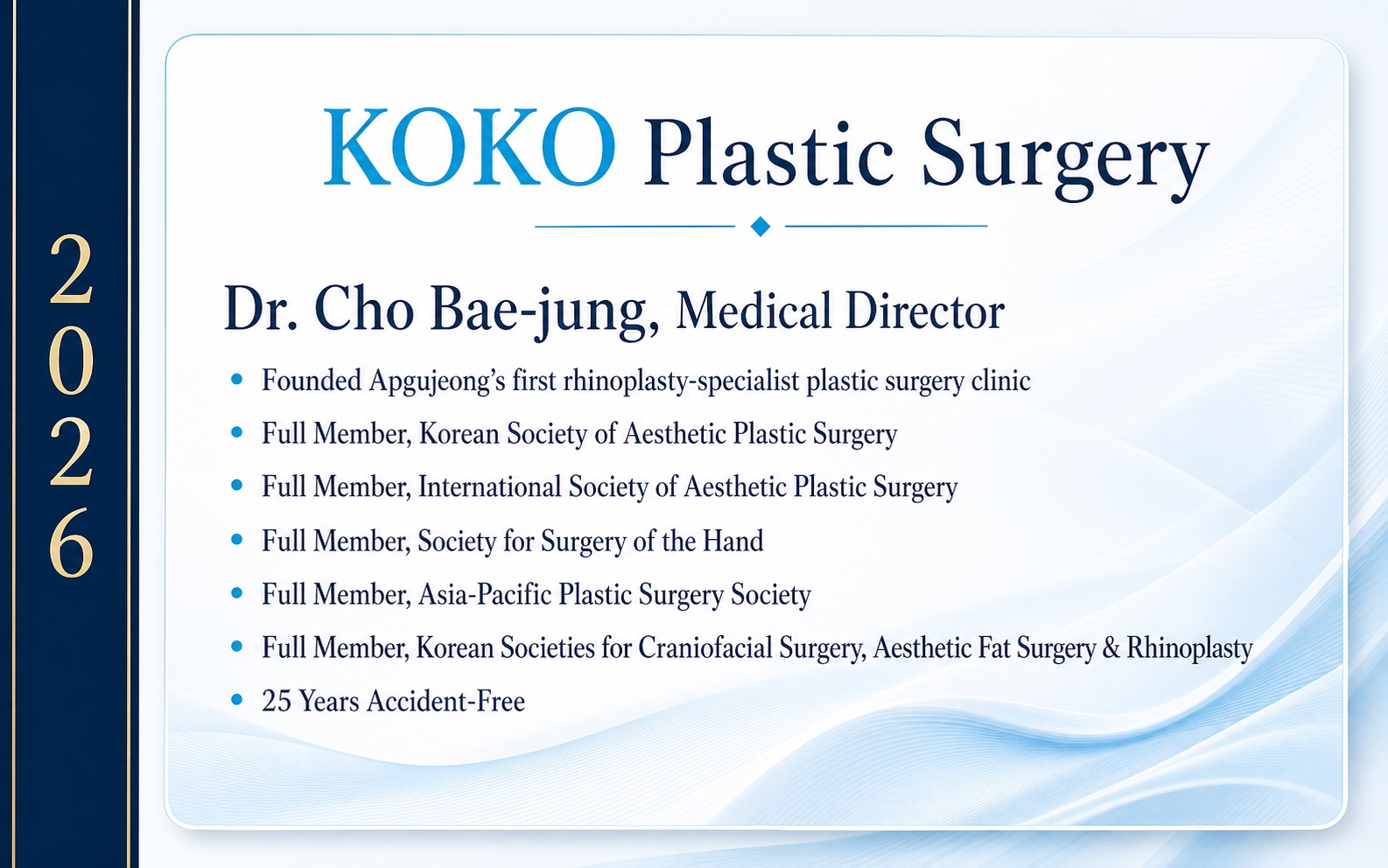
At our clinic, Chief Surgeon Dr. Bae-Jung Jo is responsible for each patient's care from the initial consultation through surgery. While rhinoplasty and revision rhinoplasty are our primary focus, the eyes are evaluated as one component of overall facial balance. Fees, indications, and the specific technique recommended are determined individually after examination and are not finalized at the counseling stage.
Frequently Asked Questions
How long does the suture method last? If the fold disappears, is full incision the only option?
No single timeframe applies to everyone. In patients with thin eyelid tissue, the fold may remain clearly defined for many years; in patients with thick skin, a strong eye-opening habit, or a tendency to rub their eyes, the fold may become shallower within a relatively short period. If the fold does fade, options include re-suturing, partial incision, or full incision — the right choice depends on the existing scar tissue, the desired width, and whether ptosis is a factor.
Will the full incision scar still be visible outside the fold line after the result has matured?
The incision is placed along the fold crease, but for the first several months after surgery it tends to be noticeable as redness or firmness. How long it remains visible depends on individual healing, any history of infection, the width of the designed fold, and postoperative trauma to the area. No surgeon can promise that the scar will become invisible.
Is it better to perform epicanthoplasty or ptosis correction at the same time as the double eyelid procedure?
Combining these procedures is possible, but doing so increases swelling and bruising and makes it harder to assess symmetry in the early postoperative period. If ptosis is present and only the fold width is widened without addressing the lifting function, the insufficient eye opening will remain apparent. The guiding principle is to limit the scope of surgery to what is genuinely necessary.
How should I plan for postoperative follow-up in Japan after having surgery in Korea?
An early postoperative monitoring plan — covering suture removal and surveillance for signs of infection — should be established before surgery, not after. If you will be transferring care to a local physician in Japan after returning home, having a complete written record of the technique, suture material, and amount of tissue removed is essential; without it, appropriate care may be delayed. Your travel schedule alone should not dictate your choice of surgical technique.
Will the result match the simulation images?
No. Simulation images are a communication tool, not a preview of your outcome. Skin thickness, scarring, swelling, and left-to-right differences in eyelid opening cannot be fully replicated in a photograph. If the desired fold width is not compatible with the available tissue, either the technique or the design goal will need to be adjusted.

For Those Who Want to Find Out Whether Full Incision or the Suture Method Is Right for Them
Indications, limitations, expected recovery, and risks all depend on your individual eyelid anatomy. Because clinical findings and fees vary from person to person, please do not make your decision based on photographs or reviews alone. We invite you to compare your eyelid structure and your goals with a specialist through an in-person visit or an online consultation. Consultations in English are available via WhatsApp.