


What You Should Know in an Age of Expanding Facelift Options
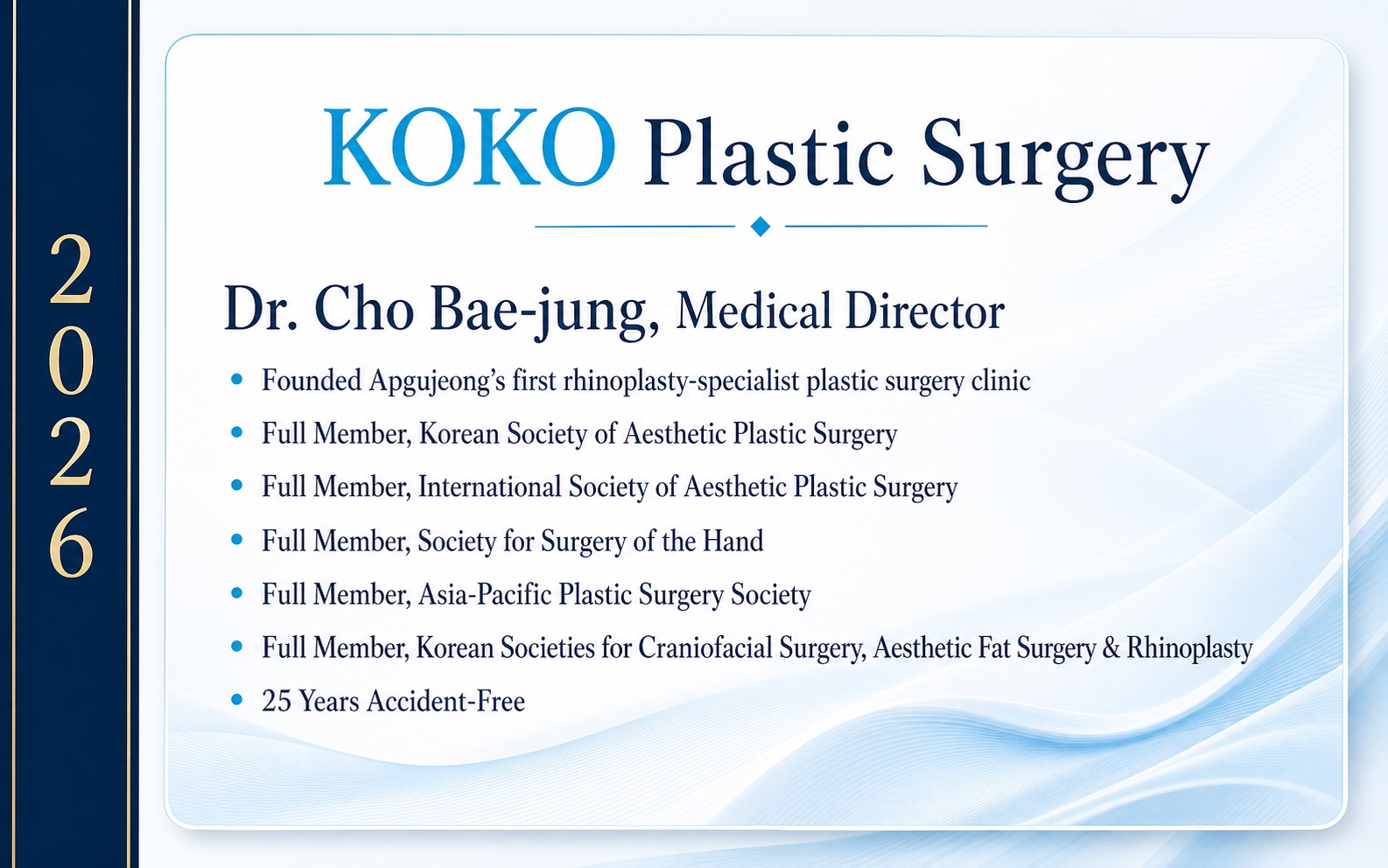
"I've started noticing sagging, but I have no idea which treatment to choose" — this is a concern we hear from a wide range of patients, from their late thirties through their sixties. Today, the world of facelifts offers multiple options, from minimally invasive thread-based procedures to comprehensive surgical techniques that address both the skin and the underlying SMAS (superficial musculoaponeurotic system). Having more choices is generally a good thing for patients, but it also makes it genuinely harder to determine which option is right for you.
At KOKO Aesthetic Surgery, we offer the Mini Lift and the Incisional Lift (SMAS Lift), with Dr. Cho Bae-jung, our Medical Director, personally overseeing every step from consultation through surgery. This article provides an overview of the three main options — thread lift, mini lift, and incisional lift — covering how each is indicated, what changes you can realistically expect, downtime, risks and individual variation, and limitations. Please note that this article is intended as general medical information only and does not constitute a personal diagnosis or treatment recommendation. Actual candidacy is determined through an in-person consultation.
The Basic Structure and Differences Among the Three Procedures
Thread Lift (Suture Lift)
A thread lift involves inserting specially designed barbed sutures beneath the skin to physically lift and reposition tissue. It requires no incisions, is typically performed under local anesthesia, and the procedure itself tends to be relatively quick. Because of its limited recovery time, it is widely known as a low-downtime treatment — however, since the lifting force is confined to the skin and subcutaneous fat layers, it has meaningful limitations when sagging involves the fascial level or when there is significant excess skin.
Thread lifts are generally considered most appropriate for patients in their thirties to early forties who have relatively mild sagging and retain reasonable skin elasticity. The duration of results varies considerably depending on the thread material, the number of threads used, and the individual's skin condition, and it is difficult to generalize. Compared with surgical procedures, repeat treatments are often needed sooner.
Following thread insertion, temporary irregularities, a sensation of tightness, and — less commonly — thread exposure or asymmetry may occur. These risks and the course of recovery vary from person to person, making thorough pre-procedure counseling essential.
Mini Lift (Limited-Incision Lift)
A mini lift involves relatively short incisions placed around the ears to lift the skin and underlying tissue, after which excess skin is excised. Because the incision length is more limited than a full incisional lift, recovery time and return to daily activities tend to be shorter in comparison. That said, the area that can be addressed is also more limited, so significant improvement of the neck, jawline, and submental region is generally less achievable than with a full incisional lift.
The mini lift is commonly considered for patients in their forties to early fifties with moderate sagging, or for those who wish to keep incisions as minimal as possible. As with any surgical procedure, appropriateness must be determined through a thorough assessment of skin condition, degree of skin laxity, bone structure, and fat distribution. Because incisions are made, standard surgical risks apply — including scarring, changes in sensation, bruising, and swelling — and individual recovery experiences vary.
Incisional Lift (SMAS Lift)
The incisional lift — particularly the SMAS lift — goes beyond lifting the skin alone by directly manipulating the deeper fascial layer of the face (the SMAS), aiming for a more fundamental and longer-lasting result. Incisions are made extending from in front of and behind the ear into the temporal region, making this the most invasive of the three options with the longest downtime. In return, it is capable of addressing a greater degree and broader distribution of sagging, and results tend to last longer.
The SMAS lift is most commonly considered for patients in their fifties or older with moderate to severe sagging who are seeking improvement of the facial contour, neck, and submental area. However, surgical candidacy depends on many factors, including overall health, medical history, smoking history, bone structure, and skin quality. Post-operatively, patients may experience swelling, bruising, altered sensation, visible scarring, and other risks, and it may take several months for the final result to settle. Individual outcomes and recovery courses vary significantly, making thorough pre-operative discussion with your surgeon essential.
Considerations by Age, Degree of Sagging, and Lifestyle
Late Thirties to Early Forties: Addressing the "Beginning" of Change
In this age group, a gradual decline in skin elasticity and shifting of facial fat can begin to manifest as deepening nasolabial folds, loss of cheek volume, and a subtle softening of the jawline. When sagging is relatively mild, a thread lift may be considered as a first option. However, depending on fat distribution and bone structure, combining a thread lift with fat grafting may be better suited to restoring facial volume and definition.
A mini lift may also become a consideration once excess skin begins to develop. There is a perspective that intervening while tissue changes are still mild allows for earlier correction, though the optimal timing and approach depends on each individual's facial condition.
Late Forties to Fifties: Confronting More Established Sagging
In this age group, increased skin laxity and the downward migration of cheek and submental fat under gravity tend to blur the definition of the jawline. Thread lifts alone may feel insufficient, and this is often the stage at which mini lifts or incisional lifts come into consideration.
For those with limited time off due to work or family responsibilities, a procedure with relatively shorter downtime — such as the mini lift — may be preferred. On the other hand, for those prioritizing longer-term results or wishing to address both the jawline and the neck and chin simultaneously, exploring candidacy for a SMAS lift is worth discussing.
Fifties and Beyond: Considering an Approach at the Deeper Structural Level
When skin laxity becomes clearly visible and fascial relaxation begins to affect the overall impression of the face, a full incisional lift with fascial-level manipulation — such as the SMAS lift — is positioned as the more foundational approach. This does not mean that once a certain age is reached, surgery is the only option; rather, the choice is made after a comprehensive evaluation of skin quality, patterns of sagging, overall health, and the degree of lifestyle impact the patient can accept.
Post-operative recovery management is also particularly important in this age group. KOKO Aesthetic Surgery offers post-operative care including hyperbaric oxygen therapy to support healing and help manage swelling. Hyperbaric oxygen therapy is believed to promote recovery by enhancing oxygen delivery to tissues, though individual responses do vary.
A Comparative Overview of Downtime and Risks
The following is provided as a general reference only. Actual recovery will vary considerably based on individual condition, the specifics of the procedure performed, and post-operative care.
Thread Lift: Swelling and bruising often subside within a few days to about a week, though a sensation of tightness or minor irregularities beneath the skin may persist for several weeks. Results are commonly cited as lasting approximately one to two years, though this varies by individual. Key risks include asymmetry, thread displacement or exposure, and infection.
Mini Lift: Swelling and bruising may persist for one to two weeks, with full resolution taking several weeks to a few months. Temporary redness at the incision site and changes in sensation are possible. Key risks include visible scarring, sensory disturbance, asymmetry, and recurrence of sagging.
Incisional Lift (SMAS Lift): Swelling and bruising may persist for one to three weeks or more, and the final result may take approximately three to six months to fully settle. Return to social activities varies by individual, though many patients plan for roughly one to two weeks of downtime. Key risks include visible scarring, rare risk of facial nerve involvement, asymmetry, rare risk of skin necrosis, and infection. The frequency and severity of these complications vary from person to person.
How to Think About Which Procedure Is Right for You
Before your consultation, reflecting on the following points will help you make the most of your appointment.
Location and degree of concern: Whether your primary concern is sagging in the cheeks, the neck and chin, or an overall loss of jawline definition will influence which procedure may be most appropriate. Mild sagging may be addressable with a less invasive approach, while significant skin laxity often responds better to procedures that include excision of excess skin.
Acceptable downtime: Taking an honest look at your work schedule, family responsibilities, and social commitments — and determining how much downtime you can realistically accommodate — is an important part of the decision-making process.
Your approach to maintenance: Some patients prefer periodic lighter treatments every few years, while others would rather undergo a single procedure with longer-lasting results. This personal preference plays a meaningful role in determining the right approach.
Overall facial balance: Lifting procedures affect the proportions and three-dimensionality of the face. In some cases, combining a lift with fat grafting or improvements to the nose or eye area creates a more harmonious overall result. At KOKO Aesthetic Surgery, consultations place particular emphasis on balance across the entire face.
Frequently Asked Questions
Q1. Can I have an incisional lift after having had a thread lift?
Performing an incisional lift while threads remain in the body is technically feasible in some cases, though the approach will depend on the condition, placement, and type of threads. If you have previously undergone a thread lift, please be sure to mention this during your initial consultation.
Q2. How noticeable will scarring be after a mini lift or incisional lift?
In both procedures, incisions are designed to follow the natural creases and contours around the ears, and with appropriate suturing technique and post-operative care, scarring is generally kept as inconspicuous as possible. That said, how well scars heal varies from person to person. If you are prone to keloid formation or hypertrophic scarring, we recommend discussing this with your surgeon in advance.
Q3. How long do the results of a facelift procedure last?
The longevity of results depends on many factors, including the type of procedure, the condition of your skin, your lifestyle habits, and the rate at which you continue to age. As a general rule, incisional lifts tend to offer longer-lasting results than thread lifts, though no procedure stops the aging process itself. For an individualized outlook, please discuss this during your in-person consultation.
Q4. If I travel to Korea for surgery, when is it safe to return home?
This depends on the procedure. For a thread lift, returning within a few days is generally feasible. For a mini lift or incisional lift, most patients wait until after suture removal — typically around one week post-surgery — before traveling home. Depending on how recovery progresses, an extended stay may occasionally be advisable. We recommend discussing a detailed schedule during your pre-travel consultation.
Q5. Does KOKO Aesthetic Surgery offer thread lifts?
The lifting procedures currently offered at KOKO Aesthetic Surgery are the Mini Lift and the Incisional Lift (SMAS Lift). If you are specifically interested in a thread lift, please let us know during your consultation and we will be happy to discuss the most appropriate options for you.
Booking a Facelift Consultation at KOKO Aesthetic Surgery
Facelift options continue to expand, and each comes with its own indications, advantages, and limitations. A one-size-fits-all approach — "at this age, choose this procedure" or "with this degree of sagging, this surgery is always the answer" — simply does not reflect the complexity of individual cases. What matters is a thorough assessment of your skin condition, degree of laxity, bone structure, and lifestyle, followed by a personalized recommendation.
Dr. Cho Bae-jung, our Medical Director, is personally involved at every stage — from your initial consultation through surgery — with a practice philosophy centered on whole-face balance and patient safety. If you are considering a lifting procedure, we encourage you to start with a consultation to carefully align your current concerns with your goals.
Start a Free Consultation via WhatsApp
Not sure whether a thread lift, mini lift, or incisional lift is right for you? Begin with an online consultation. Dr. Cho Bae-jung personally handles every case from consultation through surgery. Consultations are available in English. Details regarding procedure candidacy, fees, and scheduling depend on your individual circumstances and will be confirmed during your in-person or online consultation.
Address: 3F W Building, 830 Nonhyeon-ro, Gangnam-gu, Seoul (Apgujeong)
Consult via WhatsApp