


The idea that "plastic surgery in Korea is a bargain" still holds some truth, but the underlying assumptions are shifting dramatically from 2026 onward. Three factors demand careful attention: the VAT refund program for foreign patients, which expired at the end of 2025; the historically weak yen; and the out-of-pocket costs of travel, accommodation, and recovery. Comparing only the surgical fee while ignoring these elements makes accurate decision-making impossible. This guide breaks down each cost component in a structured way and gives you the framework to estimate your total expenditure. Please note that individual surgical fees vary widely depending on the procedure, surgeon, and clinic; all figures cited here are general reference ranges only. Always confirm exact pricing through an in-person or online consultation.
Foreign patients previously received a refund on the 10% medical VAT, but that scheme was abolished at the end of 2025. It is important to understand clearly that your actual out-of-pocket surgical costs have increased as a result.
Even when the Korean won price stays the same, the yen equivalent can fluctuate significantly with the exchange rate. Recalculating at the current rate immediately before you travel is essential.
Round-trip airfare, hotel, extended recovery stays, interpretation support, and other non-surgical expenses can account for a substantial portion of your total budget.

What Changed When the VAT refund program Ended
To promote medical tourism, South Korea had long offered a VAT (10%) refund scheme on certain medical services, including cosmetic surgery, for foreign patients. That scheme effectively ended at the close of 2025, meaning Japanese patients traveling from 2026 onward will pay more in real terms for the same procedures than they would have before.
In concrete terms, if a procedure is priced at 2,000,000 KRW, you will now be charged an additional 200,000 KRW in VAT. For combination surgeries or technically complex procedures such as rib-cartilage rhinoplasty—where the base fee is already high—the absolute impact of losing the exemption is correspondingly larger.
The end of the VAT refund program does not simply mean the "bargain factor" has diminished—it means the baseline for comparison has fundamentally changed. Cost information from before 2025, including social-media testimonials, cannot be compared directly with what you will actually pay today.
Alongside the exemption's abolition, some clinics have also been revising their pricing structures for international patients. Asking the clinic to state the current all-inclusive, tax-inclusive price before you travel is therefore the essential first step in building a realistic budget.
How the Weak Yen Actually Affects Your Total Cost
Korean plastic surgery clinics price their services in Korean won. This means the yen-denominated total you ultimately pay is directly determined by the USD/KRW exchange rate at the time.
| Exchange Rate (1 KRW) | 2,000,000 KRW in JPY | 5,000,000 KRW in JPY | 8,000,000 KRW in JPY |
|---|---|---|---|
| ¥0.085 (stronger yen) | approx. ¥170,000 | approx. ¥425,000 | approx. ¥680,000 |
| ¥0.105 (mid-range) | approx. ¥210,000 | approx. ¥525,000 | approx. ¥840,000 |
| ¥0.120 (weaker yen) | approx. ¥240,000 | approx. ¥600,000 | approx. ¥960,000 |
The table above is an illustrative example designed to make the exchange-rate impact visible; actual surgical fees will differ depending on the procedure and your individual circumstances. The key point is that a shift in the rate from ¥0.085 to ¥0.120 alone increases the yen cost of the same procedure by approximately 41%.
When planning your trip, being mindful of when you exchange currency—alongside comparing surgical fees—is a practical way to manage your real costs. That said, making medical decisions based on exchange-rate forecasts is not advisable from a clinical standpoint. Once you are ready, prioritize moving forward with a consultation at the right time for you medically.
The Full Picture of Travel and Accommodation Costs

A cosmetic surgery trip to Korea involves several out-of-pocket expenses beyond the surgical fee itself. Understanding these in advance is the foundation of any realistic budget.
- Round-trip airfare: Costs vary considerably depending on your departure city (Tokyo, Osaka, Fukuoka, etc.), the time of year, and whether early-bird fares are available. Budget carriers can reduce costs, but after surgery it is worth weighing seat comfort and total travel time against price.
- Hotel and accommodation: Staying close to the Apgujeong–Gangnam area where most clinics are located reduces commuting strain. Because your recovery may require you to extend your stay beyond your original plan, checking cancellation policies before booking is important.
- Extended recovery stay: For rhinoplasty, a minimum stay of roughly 7–10 days is generally recommended to accommodate suture removal and post-operative check-ups. Individual healing pace and clinic instructions may require an even longer stay.
- Pre- and post-operative consultation and testing fees: Blood work, imaging, and other tests associated with surgery are sometimes billed separately. Confirm in advance which tests are included in the quoted surgical fee.
- Interpretation and coordination services: If the clinic provides in-house Japanese-language support, interpretation costs are eliminated or minimal. Using an external coordinator involves a service fee, and it is worth noting that some coordinators limit your ability to negotiate directly with the clinic.
- Post-operative medications and supplies: Prescription drugs, taping materials, and topical treatments may be charged separately. This varies by clinic.
- Post-return medical care in Japan: If you need follow-up care or treatment for any complications after returning home, those costs are generally your own responsibility at a domestic medical facility.
When these expenses are added together, the surgical fee often represents a smaller share of the total than expected. Building the habit of evaluating total cost—not just the surgical fee—is the best way to avoid budget surprises.
How to Think About Cost Structures by Procedure
Taking rhinoplasty as an example, even within the category of "nose surgery," costs vary substantially depending on the materials used, the technical complexity, and the operating time. The following framework is intended as a general reference only; always confirm specific fees directly with your clinic.
Primary Rhinoplasty (Silicone Implant)
Bridge augmentation using a silicone prosthesis, or tip refinement using cartilage grafts. When no autologous tissue harvest is required, operating time tends to be shorter and costs lower, though the choice of material and design complexity will affect the final fee.
Rib-Cartilage Rhinoplasty
Costal cartilage is harvested from the chest and used to reconstruct the structural support of the nose. The harvest technique and the skill required for shaping make this procedure technically demanding and time-consuming, so it is generally more expensive than an implant-only approach. It is often chosen for patients seeking long-term stability or undergoing revision surgery.
Revision Rhinoplasty
When existing implant removal, deformity correction, or reconstruction is involved, the procedure is more complex than primary surgery and costs are typically higher. Detailed pre-operative diagnosis is essential, and the range of possible fees is correspondingly wide.
Combined Procedures (e.g., Nose and Eyes)
Performing multiple procedures simultaneously may allow anesthesia and operating-room costs to be shared, but extended downtime and additional risk-management considerations also apply. The cost structure will differ with every combination of procedures.
When comparing costs, the simple equation of "cheaper = higher risk" or "more expensive = safer" does not hold. A comprehensive evaluation of the surgeon's expertise, the clinic's facilities, and the quality of post-operative support is essential. For technically demanding procedures such as revision rhinoplasty in particular, the surgeon's experience and diagnostic ability are more decisive factors in outcomes than price alone.
The "Hidden Costs" of Risk, Recovery, and Individual Variation

Some of the most important factors in the decision-making process are rarely captured in a cost calculation—what might be called "hidden costs."
Recovery time and its impact on work and daily life: As a general guide for rhinoplasty, noticeable swelling and bruising are common in the first one to two weeks after surgery. Final results typically take several months to stabilize, and the effect on your professional and social activities during that period is a real cost that deserves acknowledgment. Recovery pace varies from person to person; swelling and wound healing after the same procedure can differ considerably between individuals.
Risk of complications and revision: All surgical procedures carry inherent risks. Should complications such as infection, bleeding, deformity, implant malposition, or cartilage resorption arise, additional treatment costs and the expense of returning to Korea may follow. Confirming the scope, limitations, and duration of the clinic's post-operative guarantee before proceeding is essential.
Follow-up care after returning home: When you have surgery in Korea, any follow-up visits after your return will be handled by medical facilities in Japan, at your own cost. Check in advance whether the Korean clinic has a structured system for remote follow-up and whether Japanese-language aftercare support is available.
Psychological and time-related costs: Travel preparation, the language barrier, information-gathering, and managing post-operative anxiety all represent burdens that cannot be quantified in monetary terms. For those undergoing surgery abroad for the first time, building a relationship of trust with the clinic through online consultations beforehand can meaningfully reduce these burdens.
A Framework for Evaluating Cost and Value at KOKO Plastic Surgery
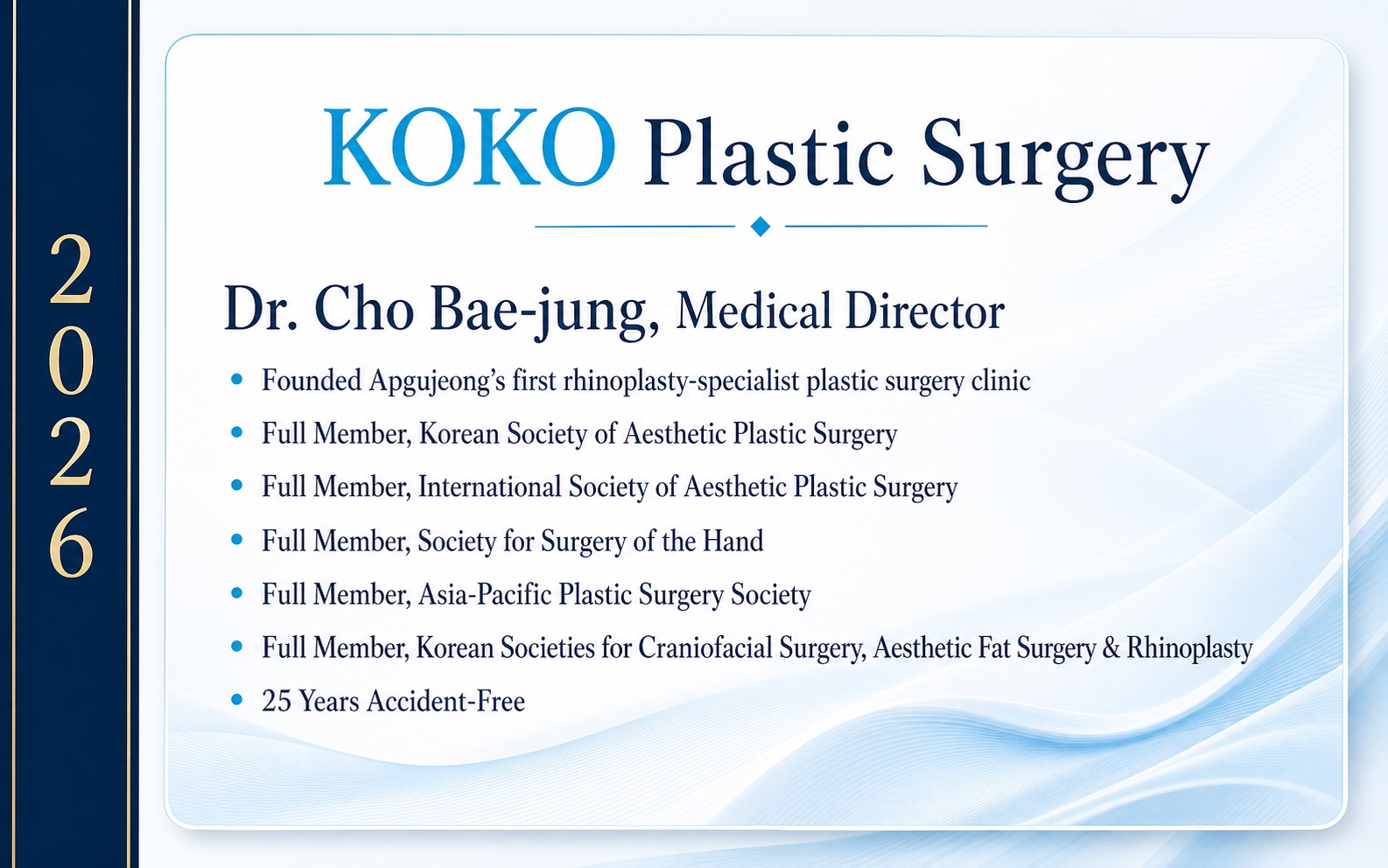
KOKO Plastic Surgery (Apgujeong, Seoul) is a clinic specializing in rhinoplasty and rhinoplasty revision. Dr. Jo Bae-jung, the clinic director, is personally involved in every case from the initial consultation through to surgery, conducting a detailed assessment of each patient's facial structure and nasal support framework before determining the appropriate technique and materials.
On the matter of cost transparency, it is the clinic's policy to provide a clear breakdown of procedure fees, materials, and associated costs during the pre-operative consultation. For patients traveling from 2026 onward—after the VAT refund program ended—the clinic provides accurate all-inclusive pricing that reflects the current tax treatment. Japanese-language online consultations via LINE make it possible to address questions and concerns before you travel.
Elements such as more than 25 years of rhinoplasty experience, post-operative care that includes hyperbaric oxygen therapy, and the capacity to handle complex reconstruction cases involving the nasal septum and rib cartilage represent dimensions of value that a straightforward price comparison cannot capture. To weigh cost against expertise according to your own priorities, we recommend beginning with a consultation.
Official Sources and Related Guides
The current Korean Restriction of Special Taxation Act, Article 107-3 states that eligible cosmetic-medical services had to be supplied by December 31, 2025. The temporary refund policy’s original purpose is documented in the Korean government’s 2015 tax revision. For procedure context, see KOKO’s rhinoplasty guide and revision rhinoplasty guide.
Frequently Asked Questions
How much more expensive has rhinoplasty in Korea actually become since the VAT refund program ended?
The 10% VAT is now added directly to the surgical fee. For a procedure priced at 3,000,000 KRW, for example, the 300,000 KRW in VAT that was previously refunded is now an out-of-pocket expense. However, because pricing structures and what is included in the quoted fee differ between clinics, it is important to confirm the current all-inclusive, tax-inclusive total directly with your clinic.
With the yen still weak, should I wait until it recovers before traveling?
Waiting for the exchange rate to improve is an understandable approach, but currency movements are notoriously difficult to predict even for specialists—no one can say with certainty when or whether the yen will strengthen. Since the appropriate timing for surgery is primarily a medical judgment, postponing for exchange-rate reasons alone is not necessarily the best course of action. Managing your currency exposure separately—through timing your foreign exchange purchases or other strategies—may be a more practical approach to consider alongside your medical planning.
How long should I plan to stay in Korea?
For rhinoplasty, a stay of at least 7–10 days is generally recommended to allow for suture removal and post-operative check-ups. Depending on how your recovery progresses and whether any additional care is needed, an extension may be required. It is advisable to plan around a period when you can take leave from work, while building some flexibility into your schedule.
What happens to costs if I experience a problem after returning home?
If you need to see a doctor in Japan after surgery performed in Korea, those consultation fees are generally your own responsibility. How much support the Korean clinic provides remotely, or whether return-visit costs are covered under any guarantee, depends entirely on that clinic's specific terms. Before proceeding, it is important to clarify the scope of the post-operative guarantee, how return travel for follow-up care is handled, and whether online aftercare support in Japanese is available.
Is it better to book through a coordinator or directly with the clinic?
Using a coordinator involves a service fee, and in some cases clinics factor that fee into the overall pricing. When a clinic can provide full Japanese-language support in-house, booking directly tends to offer greater cost transparency and easier direct communication with your surgeon. We recommend checking whether the clinic offers a direct inquiry channel—such as an official website or LINE account—through which you can contact them without an intermediary.
Get Precise Cost Details Through an Online Consultation
The cost components discussed in this article—VAT after the exemption ended, exchange-rate impact, procedure-specific estimates, and travel and accommodation expenses—are reference information intended to support your decision-making. Actual surgical fees, testing costs, and associated expenses will vary depending on your individual circumstances, the procedure involved, and the clinic's policies.
KOKO Plastic Surgery offers Japanese-language online consultations via LINE, handled directly by clinic director Dr. Jo Bae-jung. You are welcome to bring any questions you want to resolve before traveling—cost breakdowns, procedural suitability, expected recovery timelines, and more. While formal diagnosis can only be made during an in-person examination, a consultation allows you to assess the clinic's approach and confirm pricing transparency before you commit to making the trip.
Contact Us for a Free Consultation