


South Korea has become a leading medical tourism destination for cosmetic surgery, attracting patients from Japan and many other countries thanks to its high standards of care, cost advantages, and breadth of options. Yet cases continue to arise where patients undergo procedures without adequate preparation and find themselves at a loss when unexpected problems emerge after returning home. Lingering doubts about results once the swelling subsides, signs of post-operative infection, or an inability to reach the operating clinic in Korea for a revision—many of these situations can be avoided with the right information and planning.
This guide outlines the specific types of complications that most commonly surface in Japan after returning from Korea, along with practical steps for addressing each. It also explains what to look for when choosing a clinic in Korea.
Once you are back home, direct follow-up with your operating surgeon becomes difficult. If handover to a Japanese medical facility is not seamless, appropriate care can be significantly delayed.
Medical records and surgical reports are often issued in Korean only, making it difficult for Japanese healthcare providers to accept and treat returning patients effectively.
Attempting a revision without knowing the techniques, materials, and fixation methods used in the original procedure carries substantially greater risk. Proper documentation from the outset is essential.
Common types of complications reported after returning home
Problems arising in Japan following cosmetic surgery in Korea generally fall into four broad categories. Because the causes and appropriate responses differ for each, understanding these categories is the first step.
1. Dissatisfaction with results and unexpected outcomes
The timeline for post-operative swelling to fully resolve varies by procedure; with rhinoplasty, it can take several months before the final shape stabilises. During this period, patients sometimes rush to conclude that something has gone wrong. At the same time, certain changes—visible asymmetry, implant displacement, or skin discolouration—do require assessment by a specialist. Patients alone cannot easily distinguish between the two, which is why having access to a medical professional for consultation after returning home is so important.
2. Infection, haematoma, and suture-related issues
Early post-operative complications such as infection, haematoma formation, and suture exposure can manifest after you have already returned home, requiring prompt treatment at a Japanese medical facility. Without the operating clinic's contact details and surgical records, however, it becomes very difficult for a Japanese physician to determine the appropriate course of action.
3. Implant-related issues (prostheses and cartilage grafts)
Silicone prostheses used in rhinoplasty can migrate over time, or a foreign body reaction may develop. In such cases, whether documented records exist regarding the material specifications, shape, and fixation method used has a direct bearing on the feasibility of revision planning.
4. Prolonged psychological and emotional burden
Dissatisfaction with results, combined with the isolation of having no one to consult, can lead to prolonged emotional distress. Counselling services specialising in aesthetic medicine remain limited in Japan, making it all the more important to include mental health support in your plan before travelling to Korea.
Most post-operative complications become serious because of isolation. Confirming communication channels, interpreter support, and documentation handover before surgery is the single most effective form of risk management. Securing a reliable means of ongoing contact with your surgeon is the essential starting point.
The medical risks created by language barriers
Medical records, surgical consent forms, and post-operative care instructions at Korean clinics are typically prepared in Korean. Choosing a clinic without adequate Japanese-language support can lead to the following situations.
- Signing consent forms without fully understanding the content: You may proceed to surgery without accurate information about risks, alternatives, or revision policies.
- Misunderstanding post-operative instructions: Errors in following guidance on medication, facial cleansing, activity restrictions, and taping can directly affect your recovery.
- Difficulty being accepted at Japanese medical facilities after returning home: When surgical records are available only in Korean, Japanese physicians may be unable to determine the appropriate treatment, causing delays in care.
- Communication failures when raising concerns or complaints: If you cannot convey a concern accurately to the clinic, problems may be left unaddressed.
A language barrier is not merely an inconvenience—it is a direct patient safety issue. Before travelling to Korea, always confirm whether the physician and counsellors can communicate with you in Japanese and whether Japanese-language documentation can be provided.
| Item to confirm | Ideal standard | Risk if inadequate |
|---|---|---|
| Initial consultation | Japanese-speaking staff or physician handles the consultation directly | Your wishes are not communicated accurately, leading to a mismatch in the surgical plan |
| Surgical consent form | Japanese version provided and reviewed together | Risk of consenting without understanding the risks involved |
| Post-operative instructions | Written Japanese documentation covering medication and care | Misunderstood instructions delay recovery |
| Surgical record issuance | Japanese or English summary detailing technique and materials used | Japanese medical facilities are unable to accept or treat the patient appropriately |
| Post-return contact | Ongoing Japanese-language support via LINE or email | Problems arise with no one to consult, causing delayed response |
What to know before considering revision surgery
It is not uncommon for patients to remain dissatisfied with their results after returning home and to begin considering revision surgery. However, revision procedures are technically more demanding than primary surgery, and careful judgement is essential.
A general guide to timing
Evaluating results should only be done once post-operative swelling has sufficiently resolved. With rhinoplasty, the overall shape generally stabilises within three to six months, though the internal tissues may take up to a year to fully settle. Deciding that revision is necessary before this stabilisation period has passed risks undergoing unnecessary surgery. That said, certain signs requiring prompt attention—infection, significant pain, skin discolouration, or obvious implant displacement—exist independently of this timeline.
Factors that make revision surgery more difficult
- Changes to the anatomical structure caused by scar tissue formed during the primary procedure
- Insufficient donor material when cartilage harvest sites have already been used
- Difficulty planning surgery when materials and fixation methods from the previous procedure are unknown
- Increased surgical risk due to thinning of the overlying skin
For these reasons, the surgeon performing a revision procedure needs detailed information about the primary surgery. Obtaining and retaining the surgical record, documentation of materials used, and pre- and post-operative photographs from the original clinic is what preserves your future options.
Decision-making steps when considering revision surgery
- Confirm how much time has elapsed since surgery: Check whether sufficient time has passed for swelling to subside—as a general guide, at least three months. If you are experiencing urgent symptoms, seek medical attention regardless of timing.
- Inform the original clinic of your situation: The first step is to report your current condition to the clinic that performed the surgery and hear their assessment. A reputable clinic accepts responsibility for post-operative follow-up.
- Seek an independent specialist opinion: Rather than relying solely on the original clinic's view, seeking a second opinion from a surgeon who specialises in revision procedures is also important.
- Organise your documentation: Gather your consent form, materials record, progress photographs, and medication records into one set to bring to consultations.
- Clarify what you want to achieve: Putting into words which aspects you want improved, in what way, and to what degree allows for more concrete discussions with your surgeon.
Standards to apply when selecting a clinic before travelling to Korea
The most effective way to minimise complications after returning home is to apply thorough criteria at the clinic selection stage. Use the following standards as a reference and compare multiple clinics before making a decision.
Physician specialisation and continuity of care
Clinics where the same physician handles consultation, surgery, and post-operative follow-up maintain consistency of information throughout your care. When the consulting physician and operating surgeon are different individuals, there is a risk of discrepancy between what is planned and what is performed. This is particularly significant for rhinoplasty and revision rhinoplasty, where the surgeon who assessed the nasal support structure and cartilage condition being the one who operates directly affects the quality of outcomes.
Ongoing post-operative support
Whether contact from Japan is available after surgery—via LINE, email, or similar—and whether Japanese-speaking staff are on hand, makes a substantial difference to your peace of mind after returning home. Check also whether emergency contact details and response procedures are clearly stated.
Transparency of surgical records
Confirm in advance whether the clinic can provide the type of implant used, its specifications, the surgical technique employed, and intraoperative photographs. Without this information, any surgeon who may need to perform a future revision will be unable to plan appropriately.
Clarity of revision policy
Check whether the clinic's policy on revision surgery—what is covered, under what circumstances, timing, and the procedure for requesting it—is set out in writing. Explanations given verbally only can become a source of disputes later. Note that any language suggesting a specific outcome is "guaranteed" is not consistent with sound medical ethics.
Japanese-language support and post-operative care at KOKO Plastic Surgery
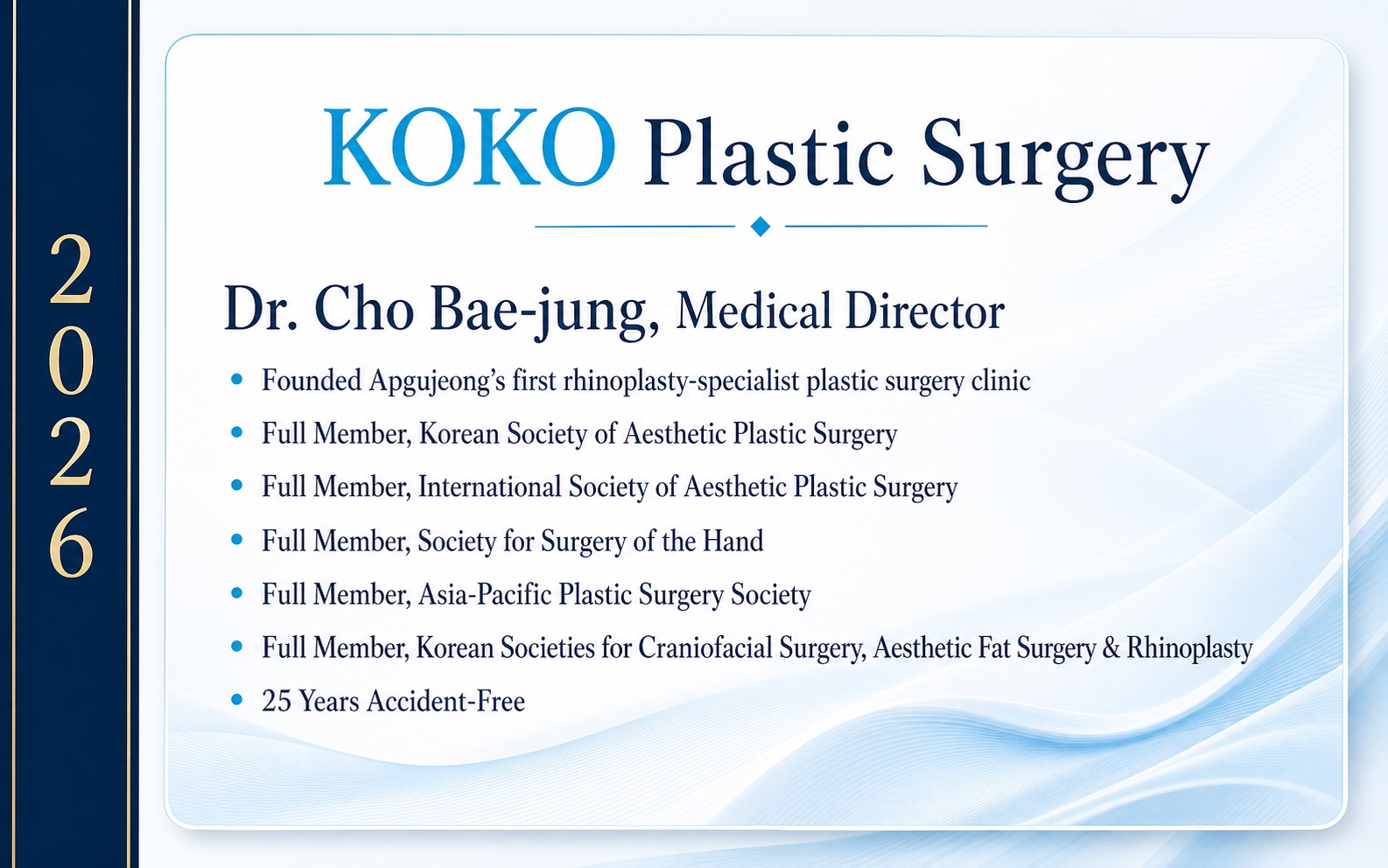
KOKO Plastic Surgery is a clinic in Apgujeong, Seoul, specialising in rhinoplasty and revision rhinoplasty. Lead surgeon Dr. Bae-Jung Cho brings more than 25 years of accumulated experience, personally managing every stage of care from consultation through surgery to post-operative follow-up.
Consistent communication in Japanese
Japanese-language communication is available throughout the entire process—from the initial online consultation, to the in-person consultation and pre-operative explanation, through post-operative instructions and follow-up after you return to Japan. Surgical consent forms and post-operative care instructions are provided in Japanese, and surgery proceeds only after your understanding of the content has been confirmed.
Continuity of care under Dr. Cho
At KOKO Plastic Surgery, Dr. Bae-Jung Cho both consults with and operates on each patient. He evaluates each individual's facial features and nasal support structure in detail, assessing from the diagnostic stage whether a reconstructive approach involving the septum or costal cartilage is necessary. This continuity of care means that the information gathered at the planning stage flows directly into the post-operative assessment and follow-up, without any break in the chain.
Post-operative care including hyperbaric oxygen therapy
A post-operative care programme that includes hyperbaric oxygen therapy is available to support recovery. By ensuring thorough in-clinic recovery management before departure, this programme is designed to reduce risk after you return home. Recovery timelines vary between individuals and are influenced by the length of your stay and your living environment. Please discuss the specifics of post-return follow-up during your consultation.
LINE support after returning home
A Japanese-language support channel via LINE is available after you return to Japan, where staff can assist with anything from minor questions to reviewing photographs of your progress. Please be aware that photo-based assessments are a supplementary measure only; if any concerning changes arise, attending a local medical facility in person should always be the priority.
Frequently asked questions
Can I receive aftercare at a Japanese hospital after having surgery in Korea?
It is possible to attend a Japanese cosmetic or plastic surgery clinic for a progress check, but if the Japanese physician is not familiar with the details of what was done in Korea, developing an appropriate treatment plan can be very difficult. We strongly recommend obtaining your surgical record, materials documentation, and a description of the technique used from the Korean clinic in Japanese or English, and bringing these to any consultation. If you experience urgent symptoms—severe pain, fever, or skin discolouration—please seek medical attention promptly, regardless of whether you have the records with you.
If I am still dissatisfied once the swelling has gone down, when should I seek advice about revision?
With rhinoplasty, the general shape tends to stabilise within three to six months of surgery, though in some cases a full year may be needed to assess the final result. Unless there is a medically urgent issue such as infection or implant displacement, it is standard practice to wait for this stabilisation period before deciding whether revision is necessary. The appropriate course of action is first to inform the original clinic of your situation, and then, if needed, to seek a second opinion from a surgeon who specialises in revision procedures.
What documents should I receive to have adequate surgical records?
At a minimum, you need a record that includes the type and specifications of the materials used (for example, the shape and size of any silicone prosthesis, and the harvest site of any cartilage), an outline of the main surgical technique, and details of any medication used post-operatively. A summary document written in Japanese or English will be extremely helpful when sharing information with a Japanese physician after your return. We recommend confirming before you travel whether the clinic is able to issue these documents.
Is it possible to have revision surgery at a different clinic from the one that performed the original procedure in Korea?
It is technically possible, but revision surgery is more complex than the primary procedure and must be planned with a thorough understanding of the original technique, materials, and the state of scar tissue. Attempting a revision without this information significantly increases risk, so obtaining the records from the original clinic is a prerequisite. Bring the documentation to a surgeon who specialises in revision procedures, seek a second opinion, and ensure you receive a thorough explanation of the risks and potential for improvement before making your decision.
What should I prepare before an online consultation prior to travelling to Korea?
Having photographs of your face from the front, side, and 45-degree angle—taken in natural light—will make it easier for the surgeon to assess your facial features and nasal structure during an online consultation. If you have had any previous aesthetic procedures, noting what was done, when, and what materials were used will help the consultation run more smoothly. Reference images of your desired outcome can also be useful, though please bear in mind that the same result cannot be guaranteed given differences in facial structure.
Confirm your support in Japanese—from before surgery to after you return home
If you are considering cosmetic surgery in Korea, choosing a clinic with support that extends from before your procedure through to your return home is the most reliable form of risk management. At KOKO Plastic Surgery, Dr. Bae-Jung Cho is personally involved in every stage—from your initial consultation and surgery through to post-operative follow-up—and Japanese-language LINE support is available after you return to Japan.
Please start by telling us your situation through an online consultation. A diagnosis and determination of surgical suitability require an in-person examination, but you are welcome to share your questions and concerns in Japanese so we can begin working through your options together.
3F W Building, 830 Nonhyeon-ro, Gangnam-gu, Seoul
Contact us for a consultation