


Why Combine Cheekbone Reduction with Rhinoplasty
The overall impression of a face is not determined by the shape of the nose or cheekbones alone. The three-dimensional balance created by the eyes, nose, cheekbones, and chin governs the harmony of the face as a whole. It is therefore not uncommon for patients to become newly aware of prominent cheekbones after rhinoplasty, or to notice that a low nose stands out more after cheekbone reduction.
Having cheekbone reduction and rhinoplasty performed at the same time offers the possibility of correcting these imbalances in a single operation with a single recovery period. That said, combined procedures carry their own specific considerations and are not suitable for every patient. This article provides thorough medical information covering indications, surgical flow, recovery, potential risks, and individual variation.
One consolidated downtime, with the final result designed around the face as a whole
Those who are concerned about both prominent cheekbones and the height or shape of their nose
Because this is a combined procedure performed under general anesthesia, your overall health and suitability must be verified with your surgeon in advance
Why a Rhinoplasty Specialist Also Performs Cheekbone Reduction
Cheekbone reduction and rhinoplasty may appear to be entirely different operations, yet they share a common medical foundation: a three-dimensional understanding of the facial bones, cartilage, and soft tissue.
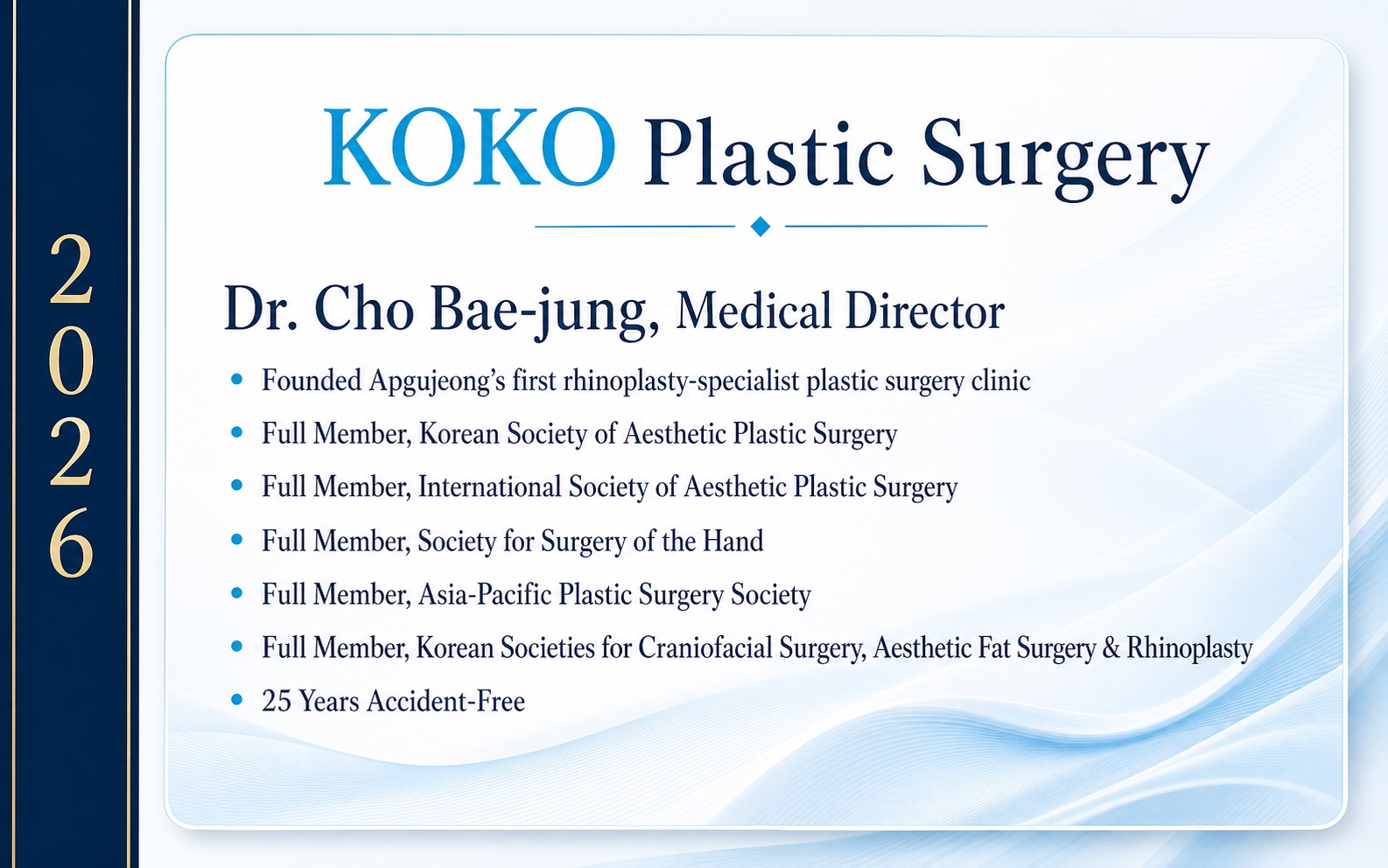
Rhinoplasty requires a thorough grasp of how the nasal bones, septum, upper lateral cartilages, and lower lateral cartilages support one another before any resection, grafting, or suturing is carried out. This spatial understanding of bone and cartilage anatomy overlaps closely with the three-dimensional spatial awareness needed to safely osteotomize and reposition the zygomatic arch during cheekbone reduction. Dr. Bae-Jung Cho, Director of KOKO Plastic Surgery, has cultivated this whole-skeleton anatomical perspective through more than 25 years of experience as a rhinoplasty specialist, and he oversees both rhinoplasty and facial contouring procedures from start to finish.
Aesthetic harmony in the face is determined not only by the quality of each individual feature but by the proportions and depth between them. In combined surgery, the three-dimensional balance of the entire face after the operation can be built into the design from the very beginning of surgical planning.
Overview of Each Procedure
Before considering a combination, it is important to have an accurate understanding of what each procedure involves.
| Item | Cheekbone Reduction | Rhinoplasty |
|---|---|---|
| Main technique | Osteotomy and medial repositioning of the zygomatic body and arch (e.g., L-shaped osteotomy) | Tip plasty, dorsal augmentation, septal extension graft, hump reduction, etc. |
| Anesthesia | General anesthesia | General anesthesia or intravenous sedation (depending on technique) |
| Incision sites | Intraoral mucosal incision and small sideburn incision | Columella (open approach) or inside the nostril (closed approach) |
| Fixation and compression | Screw fixation, head compression bandage | Nasal splint and taping |
| Peak swelling | Approximately 3–5 days post-op | Approximately 2–4 days post-op |
| Return to social activities | 7–14 days (varies by individual) | 7–10 days (varies by individual) |
| Stabilization period | Approximately 6–12 months for bone | Approximately 3–6 months for cartilage integration |
The figures above are general reference points only. The actual techniques used and recovery course vary considerably depending on each patient's bone structure, cartilage condition, medical history, and lifestyle. Please do not make decisions based on these numbers alone — always confirm with your surgeon at an in-person consultation.
Benefits and Considerations of Combined Surgery
The primary reason patients choose combined surgery is to consolidate their downtime. However, understanding both the benefits and the important considerations clearly is what leads to a satisfying outcome.
Benefit 1: One Consolidated Recovery Period
For patients who find it difficult to take extended time off work or to travel repeatedly, combining two procedures into one operation — and one period of rest — is a significant practical advantage. Although the swelling and bruising during the first few days may appear more pronounced, the total recovery time tends to be shorter than it would be if the procedures were staged separately.
Benefit 2: The Entire Face Is Designed at Once
When the nose and cheekbones are operated on separately, patients sometimes find — only after seeing the first result — that they want the other area changed as well. With combined surgery, the harmony of the whole face can be incorporated into the design from the very start of pre-operative planning.
Benefit 3: Anesthesia Risk Is Incurred Only Once
While anesthesia risk does not simply accumulate with each additional procedure, it is nonetheless a rational choice to limit exposure to general anesthesia to a single occasion.
Consideration 1: Longer Operating Time
Performing two procedures in one session naturally extends the total operating time. The increased physical demands and potential for greater blood loss must be carefully assessed together with your surgeon beforehand.
Consideration 2: Greater Overall Swelling
Cheekbone reduction alone already produces extensive edema; adding rhinoplasty means swelling spreads across the entire face. Patients should plan for restrictions on going out and regular daily activities during the first one to two weeks after surgery.
Consideration 3: Greater Complexity If Revision Is Needed
In the unlikely event that either area requires revision, careful planning must take place once both sites have fully healed. This makes consistent post-operative follow-up and scheduled check-ups especially important.
Recovery Timeline and General Milestones
The following describes a typical recovery course when cheekbone reduction and rhinoplasty are performed together. Individual variation is significant, so please set your actual schedule in consultation with your surgeon.
- Day of surgery – Day 2: Head compression bandage and nasal splint are in place. Swelling and bruising begin to develop across the face. Rest is the top priority. Post-operative care such as hyperbaric oxygen therapy may be initiated during this period.
- Days 3–5: Swelling typically reaches its peak. Periorbital bruising may appear. The head bandage may be partially loosened during this time.
- Days 7–10: Nasal splint is removed. Sutures are taken out (intraoral sutures may be removed slightly later). Swelling begins to subside, though visible changes may still be difficult to appreciate at this stage.
- Weeks 2–4: Light social activities and going out gradually become possible (individual variation applies). Some numbness or a sensation of tightness around the cheekbone area may persist. Wearing a mask makes returning to daily life more manageable.
- Months 1–3: Swelling settles considerably and the general shape of the result begins to emerge. Subtle residual edema is still present during this phase.
- Months 6–12: Bone and cartilage have fully stabilized and the final result can be assessed. Regular check-ups with your surgeon during this period are important.
For patients traveling from Japan to Seoul for surgery, it is advisable to plan for a stay of at least 7–10 days after the procedure. The actual length of stay required will vary depending on the combination of techniques and each individual's pace of recovery.
Risks and Individual Variation
Every surgical procedure carries inherent risks. In combined surgery, the risks associated with each individual procedure exist alongside one another. The following are representative examples. They do not occur in every patient, and the frequency, severity, and course differ from person to person.
- Swelling and bruising: The most common post-operative responses. The extent and duration vary by individual.
- Sensory changes: Numbness around the cheek or upper lip area may occur after cheekbone reduction. This typically improves over time, but recovery may take several months.
- Asymmetry or contour irregularities: These may arise from the positioning of bone segments after osteotomy or from changes in cartilage graft shape.
- Infection and wound complications: Careful hygiene of the intraoral incision site is essential. Appropriate antibiotic use is required.
- Rhinoplasty-specific risks: When an implant is used — infection, visibility through the skin, or displacement. When autologous cartilage is used — risks at the donor site.
- Anesthesia-related risks: A thorough pre-operative physical assessment and coordination with the anesthesiologist are essential.
- Possibility of revision surgery: The need for revision cannot be entirely ruled out.
These risks can be minimized through careful pre-operative evaluation, appropriate investigations, and thorough surgical planning, but they cannot be reduced to zero. When considering surgery, the most important step is to have your individual condition accurately assessed by a surgeon during a consultation.
From Consultation to Surgery at KOKO Plastic Surgery
At KOKO Plastic Surgery, Director Dr. Bae-Jung Cho oversees the entire process from consultation through to surgery. When combined surgery is being considered, the initial consultation involves a thorough assessment of both the nose and cheekbones, followed by a diagnosis of whether the combination is appropriate before any plan is formulated.
Post-operative care including hyperbaric oxygen therapy is also available at the clinic to help manage swelling and support recovery. Japanese-language communication is available throughout, so patients can use our services without language concerns — from an online consultation before traveling to follow-up care after returning home.
Because costs, techniques, and indications vary considerably by individual, these are not specified in this article. Please confirm all details through an individual in-person or online consultation.
Frequently Asked Questions
How long will the swelling last if cheekbone reduction and rhinoplasty are done at the same time?
Individual variation is considerable, so no single answer applies to everyone. That said, peak visible swelling typically occurs around days 3–5 after surgery, and many patients find it takes two to four weeks before swelling subsides enough to return to normal social activities. Full bone stabilization and the final result may take anywhere from six months to one year to fully emerge. It is important to monitor your progress at regular check-ups with your surgeon.
Can everyone have combined surgery?
No — combined surgery is not appropriate for every patient. Depending on overall health, bone structure, and the specific combination of procedures being considered, a staged approach may sometimes be the safer choice. Whether you are a suitable candidate is determined by your surgeon following an in-person examination and any necessary investigations. Please do not make this decision on your own — a consultation is essential.
If I travel from Japan for combined surgery, how many days do I need to stay?
This depends on the combination of procedures and each individual's pace of recovery, but most patients plan for a stay of at least 7–10 days after surgery. Given the timing of intraoral suture removal and splint removal, we recommend discussing and confirming your specific length of stay with your surgeon during a pre-operative consultation.
Is combined surgery possible if I have previously had revision rhinoplasty?
A history of revision rhinoplasty can mean that adhesions or scar tissue are present inside the nose, which may affect the complexity and planning of surgery. However, this does not automatically rule out combined surgery. What matters is a detailed pre-operative evaluation of the nasal condition, after which your surgeon can determine whether a combined or staged approach is more appropriate. KOKO Plastic Surgery handles both revision rhinoplasty and facial contouring procedures, and we are experienced in developing plans that address complex, combined situations.
Is it possible for the face to look larger after cheekbone reduction?
During the period of significant post-operative swelling, the face may appear fuller than usual. This is a temporary part of the healing process. As the swelling resolves, the effect of the cheekbone reduction becomes visible. That said, how noticeable the final change appears will vary depending on the amount of bone movement, the underlying facial structure, and subcutaneous fat thickness. Discussing expectations and reviewing simulations with your surgeon beforehand can help minimize any gap between expectation and outcome.

Free Online Consultation at KOKO Plastic Surgery
If you are considering combined cheekbone reduction and rhinoplasty, we recommend first confirming your individual suitability through an in-person or online consultation. At KOKO Plastic Surgery, Director Dr. Bae-Jung Cho oversees everything from consultation through surgery, and we are committed to clear, thorough communication in Japanese. Because costs, techniques, and indications all vary by individual, please do not rely on general information alone — we warmly welcome your enquiry.
Contact Us for a Free Consultation3F W Building, 830 Nonhyeon-ro, Gangnam-gu, Seoul | Japanese language support available